

Ultra-lifelike plants for tambour planter tops — fitted flush, Australia-wide
Everything you need to know before you buy a tambour unit, and how to make the planter box on top look brilliant — from the team that supplies and installs the plants for businesses and government departments across the country.
The 10-second version: Tambour units are the sliding-door storage cabinets in most Australian offices. Buying one? Jump to the best Australian brands — we don't sell the units, so it's honest advice on which ones are worth your money. Got planter boxes on top? That's us. We supply ultra-realistic artificial plants and install them in tambour tops Australia-wide — every plant fitted perfectly flush, whatever brand of unit you own. See how it works or get in touch.
In this guide: What is a tambour unit · Sizes & what to check · Best brands · Planter tops · How we green them · Best plants · FAQ
How it works
contact@artificialplantshop.com.au
— that's the whole job.
Here's a strange admission from a plant company: we know an awful lot about office cabinets. When you've spent years fitting greenery into the planter tops of tambour units all over Australia, you end up knowing the units themselves inside out — the sizes, the brands, the little details that make one a better buy than another. This guide is all of it in one place. We don't sell tambour units and never will, so consider this advice from the one party in the room with no cabinet to sell you.
What is a tambour unit?
A tambour unit (you'll also see tambour cabinet and tambour door cabinet) is an office storage cupboard with sliding doors made of linked slats. Instead of swinging outwards like a normal cupboard, the doors glide sideways and disappear into a recess inside the cabinet. That's the whole trick — and it's a very good trick in an office, because nothing swings into a walkway, nobody's monitor gets clipped, and two people can stand at an open unit without playing door-tetris.
They're typically steel, lockable, and internally fitted with adjustable shelving or file rails. You'll find them lining the walls of nearly every serious Australian office fit-out, and increasingly doing double duty as room dividers in open-plan spaces.
Why fit-outs keep choosing them
Storage density. Sliding doors mean units can sit shoulder-to-shoulder along a wall or back-to-back in the middle of a floor, with zero clearance wasted on door swing.
Zoning. A bank of tambour units is the quiet workhorse of open-plan design: it divides teams, creates corridors and breaks up noise without a single stud wall going in.
Security and compliance. Lockable steel units are the standard answer for document retention and clean-desk policies — one reason they're a fixture in government and corporate fit-outs alike.
The top is usable real estate. This is the part most buyers discover afterwards: that long, flat top surface at eye height is either a dust shelf and a mess magnet… or the best spot for greenery in the entire office. More on that below — it's the bit we know best.
Sizes and configurations worth knowing
Ranges vary by brand, but the pattern across Australian suppliers is consistent:
- Widths: 900mm and 1200mm are the standard widths stocked by major retailers. Banks of units are built by combining them.
- Heights: most ranges run from bench-height units up to full-height cupboards, usually described as small, medium and large within each range.
- Materials: steel dominates the commercial market for durability and fire/security ratings; laminate options exist where warmth matters more than toughness.
- Interiors: adjustable shelves, suspension-file rails, or pull-out frames — decide what's living inside before you buy, not after.
The pre-purchase checklist we'd use: published warranty length, welded (not bolted) construction, lockable as standard, anti-tilt design — and whether the range offers a matching planter box top. That last one matters more than most buyers realise: it's far easier to green a unit whose maker sells a purpose-built planter than to retrofit one that doesn't.
The best tambour unit brands in Australia
Our criteria are simple: a published warranty, an Australian presence, real range depth, and — because it's what we do all day — whether a planter-top option exists. And a note on our neutrality: we don't sell any of these, and we don't take a cent from any of them. Our greening system is made to fit whichever unit you choose, so we genuinely don't mind which one that is. That's precisely why you can trust this list.
- AusFile — steel storage specialist whose tambour cupboards come with a matching planter box top as a catalogue item. If greenery is part of your plan from day one, that's a tidy path.
- Rapidline (FurnX) — the "Go" range — probably the most widely stocked tambour range in the country, in steel and laminate finishes, with a dedicated Go planter box built for the tops. Easy to source, easy to extend later.
- Eastern Commercial Furniture (ECF) — advertises Australian-made units with fully welded construction and a 10-year warranty. Worth a look if buy-local and build quality top your list.
- OLG — office furniture wholesaler with a solid tambour range, commonly found through dealer networks alongside larger fit-out packages.
- Statewide Office Furniture — makes planter boxes designed to suit tambours (theirs and others), useful when you're adding planters to units you already own.
Details reflect each brand's published information at the time of writing — confirm specs and warranties directly when you buy.
The planter box top: the best square metres in your office
Most major tambour ranges offer a planter box that sits flush on top of the unit — typically a steel tray with three or four round pot holes (usually around 200mm across) and a full-length drip tray underneath. Arrange a few units in a row and you've suddenly got metres of continuous garden bed running through your office at exactly eye height.
Done well, it's the highest-impact greenery in the building: it softens the acoustics, turns storage into a design feature, and gives an open-plan floor the kind of warmth that no amount of carpet tile ever will. Done badly — wrong pot sizes, plants slumped below the rim, foam blocks shedding crumbs into the drip tray — it reads as an afterthought. The difference is entirely in the fit.
How we green them: plants that fit like they grew there
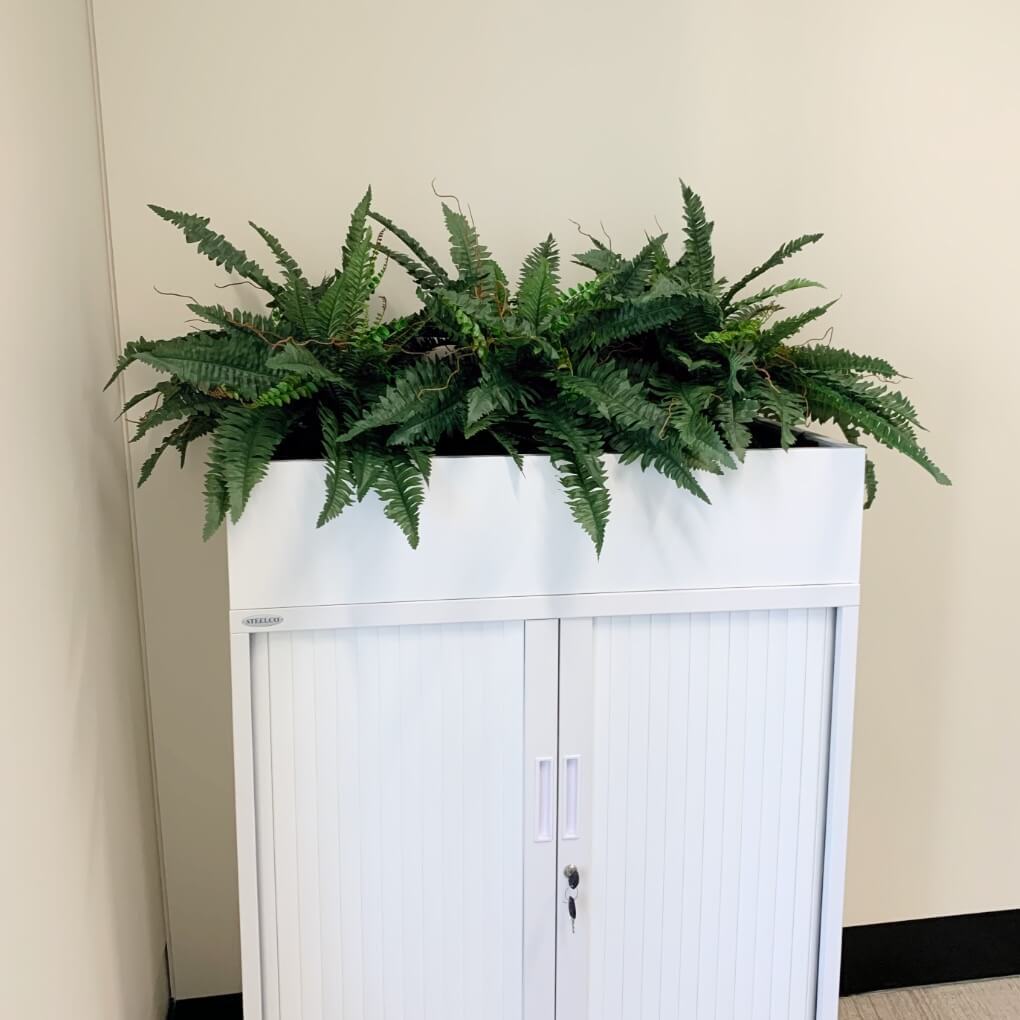
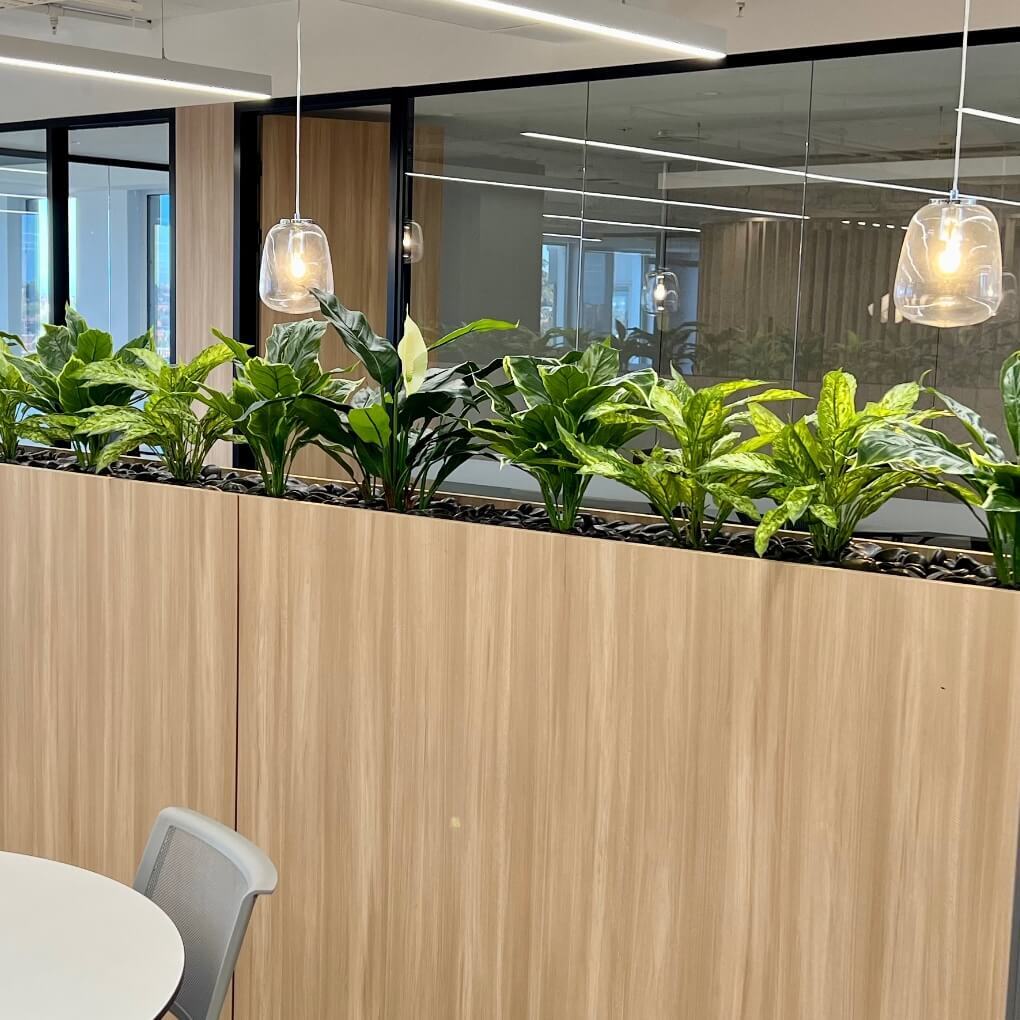

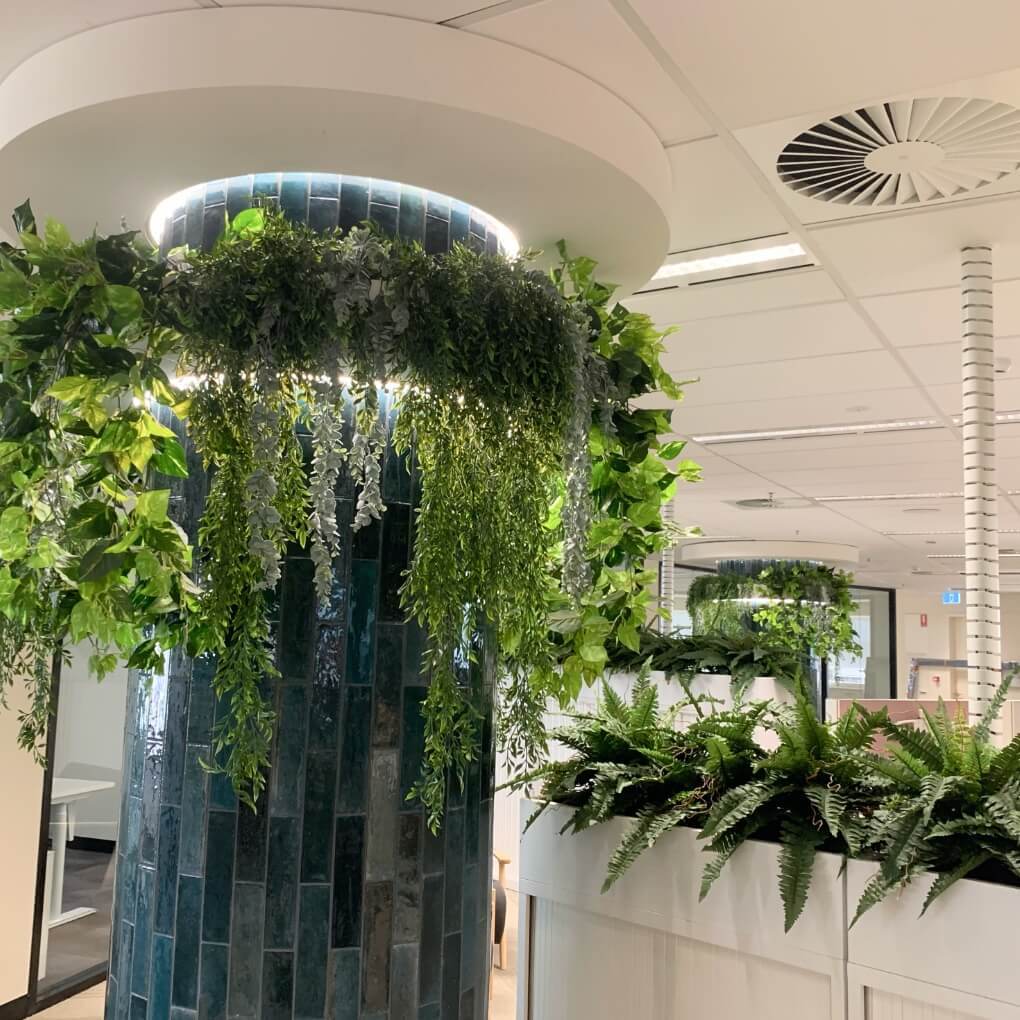
Here's the problem nobody warns you about: every planter top has one fixed hole size — and the plants you actually want come in every size but that one. The usual workaround is wedging pots in with florist foam — which costs money, sheds everywhere, and still leaves plants sitting at odd heights.
We solved it properly. Every installation is made to measure for your exact units — whatever the brand, whatever the hole size — using a fitting method we developed in-house (and keep to ourselves). The result: every plant sits perfectly flush at the rim, as if it grew there. Which means:
- Any plant you like. You choose from our full range on looks alone — the fit is our problem, not yours. No more "which pots happen to fit the holes."
- No foam, no fillers, no waste. Nothing to crumble, nothing to replace, no money spent on packing material that exists to be hidden.
- A finish that survives scrutiny. Flush, level, and uniform along the whole bank of units — the detail your visitors won't consciously notice, and would absolutely notice missing.
One thing to know: this isn't something you can buy off the shelf — from anyone else. It's made to measure for every job, and it comes exclusively with our complete supply-and-install service. And to be clear: the units and planter boxes themselves come from your furniture supplier — what we supply and install is the plants, fitted perfectly to whatever you've bought.
And no — made to measure doesn't mean expensive. It's usually the opposite. Because nothing is spent on foam inserts and filler materials that exist only to be hidden, the made-to-measure fit keeps the cost of greening each planter box down: you're paying for plants you can see, not packing you can't.
Clients sometimes ask which tambour brands we've worked with; the honest answer is that we stopped needing to keep track, because every fit-out is measured to the unit in front of us.
We've greened tambour tops and office planters for businesses and government departments across the country — including the kind of clients we're not allowed to name, doing the kind of work that has to pass procurement, facilities and the person who sits next to it every day.
Planning a fit-out, or staring at a row of bare tambour tops right now?
Send us a photo and the unit measurements — we'll suggest plants that suit your space, show you how it all comes together, and take it from there.
Enquire about your planter boxes
Prefer to talk it through? Call 1300 656 440 — or see our commercial installations.
The best plants for tambour planter tops
Whether you install with us or do it yourself, the same rules apply up there:
- Get the height right. Aim for foliage roughly one-and-a-half to two times the visible planter height — tall enough to read as intentional, low enough that people can still see (and talk) over it.
- Ferns are a favourite, not a rule. Boston ferns spill over the rim and hide the hardware completely. But our installs run from peace lilies to trailing greenery to full mixed plantings — any plant can go up top when the fit is right.
- Mix in structure. Upright growers like mother-in-law tongue or peace lilies between softer ferns stop a long run of planters looking like one continuous hedge.
- Think about cleaning day. Up top, dust is the only maintenance artificial plants need — broad, wipeable leaves make that a thirty-second job.
- Artificial earns its keep up high. Planter tops sit above the light that reaches desks and nowhere near a tap. It's the exact spot where live plants quietly give up — and where nobody can tell ours aren't.
Browse the full collection on our Planter Box Plants page, or see what we've paired for offices on the Office Plants page.
Frequently asked questions
What is a tambour unit used for?
General office storage — files, supplies, archive boxes — anywhere floor space matters, since the sliding doors need no swing clearance. Banks of them also double as room dividers in open-plan offices, especially with planter tops fitted.
What is a tambour door?
A door made of linked slats that slides sideways and rolls away into the cabinet body instead of swinging open. The same mechanism as a classic roll-top desk, turned on its side.
What goes on top of a tambour unit?
Most ranges offer a matching planter box top — a flush steel tray with three or four pot holes and a drip tray. Fitted with plants, it turns storage into eye-height greenery; left bare, it collects dust and stray staplers.
Should I use live or artificial plants in an office planter top?
Planter tops are hard territory for live plants: low light, no drainage plumbing, and watering that depends on whoever remembers. Quality artificial plants give the same look permanently, with dusting as the only upkeep — which is why they're the standard choice in commercial fit-outs.
Do you install the tambour units or planter boxes themselves?
No — the cabinets and planter box tops come from your furniture supplier. What we supply and install is the greenery: plants selected for your space, fitted perfectly flush in the planter tops.
Do you sell tambour units?
No — and on purpose. We green them. Every installation is made to measure, so it fits any brand's planter top; buy the unit that suits your fit-out (the brands above are a good start) and we'll make the top of it the best-looking part of your office.
Ready to see what your tambour tops could look like?
One photo, two minutes. We'll help you choose the right plants for your planter boxes and handle the rest.
Or call 1300 656 440 — Australia-wide plant supply & install.